
The clean label upgrade 2026 is no longer just a trend—it’s a regulatory reality. If you’ve been waiting for a sign that the clean label movement has finally hit its stride, look no further than February 5, 2026.
On that date, the FDA issued a notable enforcement discretion policy that opened a much clearer path for manufacturers that want to claim "No Artificial Colors" on their labels. For years, the rule was straightforward and frustrating: even if you replaced Red 40 with beet juice or another naturally derived color, any added color could still complicate that claim. In practice, that kept many brands from making a statement consumers immediately understood.
That policy position has now shifted in a meaningful way, though manufacturers should still treat it as enforcement discretion rather than a permanent statutory rewrite.
This isn't just a regulatory update. It's a strategic opening. At McBoeck, we see 2026 as the year of the clean label upgrade—the moment when consumer demand, regulatory momentum, and formulation capability finally line up. Here's what manufacturers need to understand now.
What the FDA Actually Changed — and What It Didn't
The February 5 FDA announcement has three parts manufacturers need to understand clearly.
First, the enforcement discretion policy. The FDA said it does not intend to take enforcement action against food products labeled with "No Artificial Colors" when those products do not contain certified color additives. Products that still contain certified synthetic color additives remain exposed to enforcement risk. That is the headline shift, and it matters.
Second, the agency moved forward on natural color tools the market has been waiting for. Beetroot red was listed as a color additive exempt from certification, and spirulina extract received broader use approvals across additional food categories. Those approvals expand the formulation toolkit for brands reformulating away from synthetic dyes.
Third, there is an important caveat: implementation timelines and practical rollout can still shift. Industry objections and regulatory process delays can affect when specific approvals are fully usable in market. That does not change the strategic direction, but it does mean manufacturers should confirm current status before locking in reformulation deadlines tied to any one color system.
The broader context matters just as much. FDA and HHS have signaled a wider push away from petroleum-derived synthetic dyes, including increased pressure on colors such as Red No. 40, Yellow No. 5, Yellow No. 6, Blue No. 1, Blue No. 2, and Green No. 3. Some target dates and compliance expectations may still evolve due to agency action, litigation, or enforcement discretion, so treat them as directional—not absolute. But the direction of travel is clear: the market is moving toward natural colors, and the question is whether your supply chain is ready.
The Red 40 Problem: Why Petroleum is Now a Liability
If your formulation still relies on Red 40, Yellow 5, or Blue 1, you aren't just using old technology—you're carrying a growing commercial liability.
Consumer sentiment has turned sharply against petroleum-derived additives. Parents are scanning labels for Red 40 with the same intensity they once reserved for trans fats, and retailers are paying closer attention to ingredient decks that can become reputation flashpoints. Beyond the marketing optics, the compliance burden tied to synthetic dye phase-outs and reformulation cycles is rising.
The strategic question is no longer whether to transition. It's whether you transition on your terms or on the market's terms.
At McBoeck, we've seen rising demand for supply chain insights that track the availability, pricing, and formulation implications of natural color alternatives. The shift is underway, and the manufacturers that move early will be in a stronger position to secure supply and protect margin.
The Three Color Solutions — and the Truth About Each
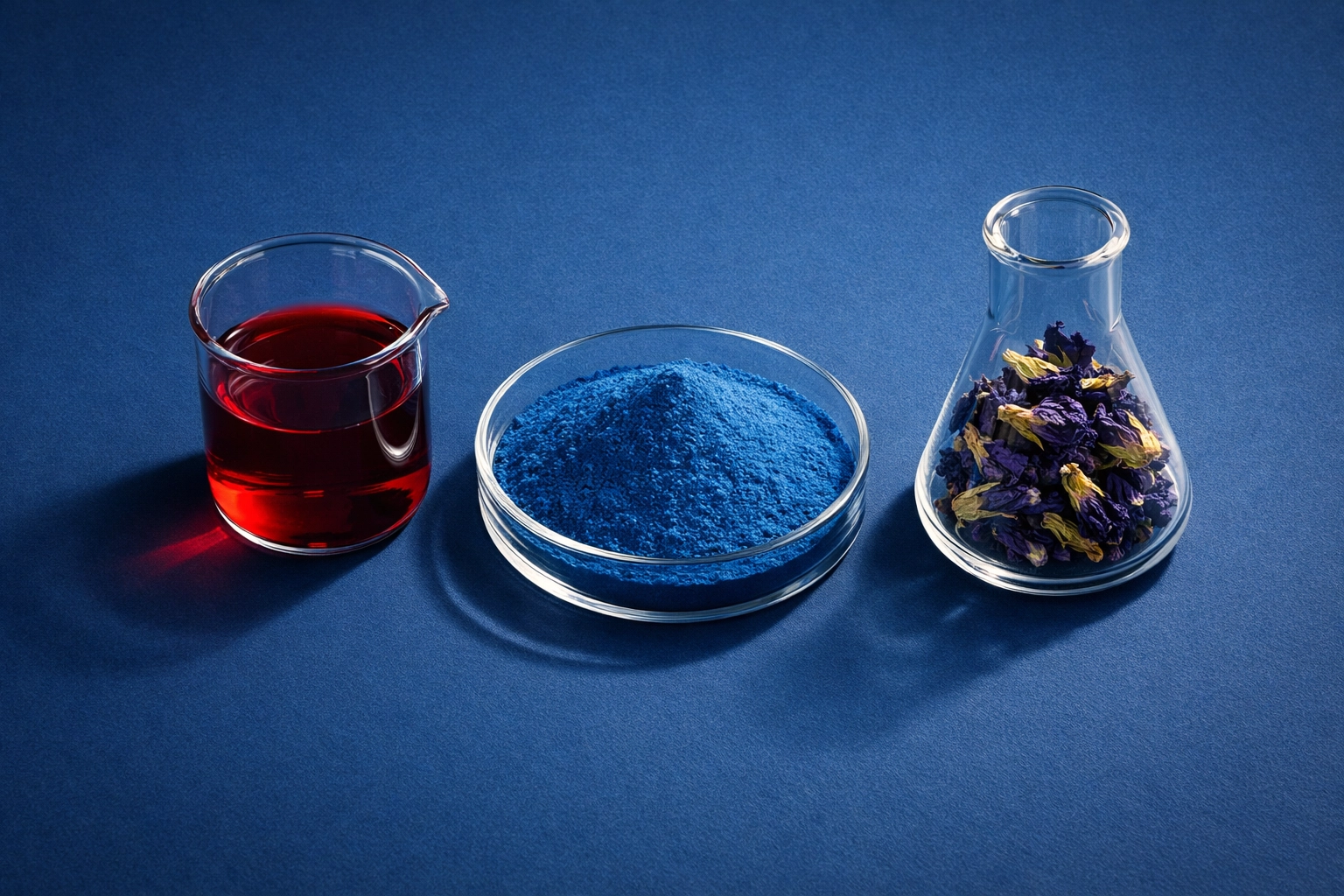
Not all natural colors are equal. Three botanicals are driving much of the 2026 clean label upgrade conversation, and each comes with a different performance profile manufacturers need to understand before reformulating.
1. Beetroot Red — The Stability Powerhouse for Reds and Pinks
For years, beetroot red was often criticized for limited heat stability. More recent advances in encapsulation and emulsification have improved how natural color systems can perform in select applications, including extended shelf-life support and better handling under processing stress. That has made beetroot red a more practical option for reds and pinks across confectionery, yogurt, gummies, plant-based meat, and some beverage systems.
Best applications: Confectionery, plant-based meat, yogurt, gummies, pink beverages.
Key formulation note: pH management matters. Beet betalains typically perform best in neutral to mildly acidic environments.
2. Spirulina Extract — The Natural Blue, with Honest Limitations
Spirulina extract helped solve one of the hardest problems in food color formulation: natural blue. It can deliver a vibrant blue-green shade and now has broader regulatory relevance in more food categories. But it is not a universal fix. Spirulina can be challenged by low-pH systems and elevated heat, which means formulators should be careful in acid beverages and aggressively processed products.
Best applications: Frostings, coatings, dairy, neutral-pH beverages, confections.
Where to be cautious: High-acid beverages, heat-processed products, and long shelf-life systems at low pH.
3. Butterfly Pea Flower — The Visionary's Choice
Butterfly pea flower extract was approved before the February 2026 announcement, but it belongs in every reformulation discussion happening now. Its pH-sensitive shift from blue to purple or pink is not just a technical quirk. In the right product, it is a premium feature.
For RTD beverages, mixers, and experiential formulations, butterfly pea flower can turn color into visible differentiation. It is approved for a range of applications including beverages, candy, dairy, and frozen desserts, and it can support bright blues, purples, and certain green systems depending on formulation design.
Best applications: Premium RTD beverages, spirits and mixers, functional elixirs, ice cream, hard candy.
Formulation advantage: Heat tolerance in many applications, visually dramatic pH response, strong clean label appeal.
🧠 McBoeck Insight: The Supply Squeeze Is Coming
Here is what many manufacturers still are not mapping clearly: this regulatory opening could trigger a simultaneous reformulation push across major food and beverage brands.
Natural food colors depend on agricultural and biological feedstocks. Beetroot supply is tied to crop output, post-harvest handling, and extraction yield. Spirulina depends on controlled cultivation systems that cannot be scaled overnight without quality and consistency risks. That means qualified supply can become a premium asset quickly when demand spikes.
We've seen versions of this pattern before with citric acid, ascorbic acid, and other high-demand ingredients. When regulatory pressure accelerates reformulation across hundreds of manufacturers, pricing often follows within 12 to 18 months.
This is not a "wait and see" moment. It is a "secure your volume early" moment.
Real-World Application: The Reformulation Bridge
Transitioning from a synthetic dye to a botanical pigment is rarely a 1:1 swap. You may need to adjust phosphoric acid or citric acid levels to protect color stability. You may need a hydrocolloid such as xanthan gum to help keep pigments suspended in beverage systems. And you may need to re-evaluate processing temperatures against the specific stability profile of your chosen natural color.
This is where system thinking becomes a competitive advantage. The manufacturers that treat clean label reformulation as a full formulation strategy—not a simple ingredient swap—are the ones most likely to get it right the first time.

Why the Window Is Open Now — and Closing
The clean label upgrade 2026 opportunity is real and time-sensitive. According to the FDA’s official color additives list, natural alternatives are now approved for broad food use. By 2028, this clean label upgrade may be closer to table stakes.
The brands that pursue a clean label upgrade 2026 strategy have a chance to own the differentiator. The brands that wait may find themselves explaining why they are still reformulating after the market has already moved.
This is also the right moment to evaluate your broader ingredient system. If you're already opening up the formula to change color, can you also improve texture with label-friendly enzymes? Can you strengthen your traceability story? The clean label upgrade is not just a packaging claim. Done right, it is a full product and brand upgrade.
Start Your Clean Label Upgrade 2026: The Window Is Open
At McBoeck, we support your clean label upgrade 2026 journey with verified, U.S.-stocked natural color ingredients—including beetroot red, spirulina extract, and butterfly pea flower extract—from our hubs in Houston and Los Angeles. We track the regulatory calendar, supply chain constraints, and formulation realities so our partners are better prepared for shortages, pricing pressure, and shifting compliance expectations.
The 2026 opening is here. Consumer demand is here. The supply window may not stay wide for long.
The question is simple: will your label be the one customers trust?
Ready to start your clean label upgrade?
Explore McBoeck's natural color portfolio or join our Partner Program to stay ahead of ingredient trends and supply developments.
📌 Action Point: Contact the McBoeck ingredient strategy team to audit your current formulations and identify your fastest path to a verified, supply-chain-secured clean label upgrade.