
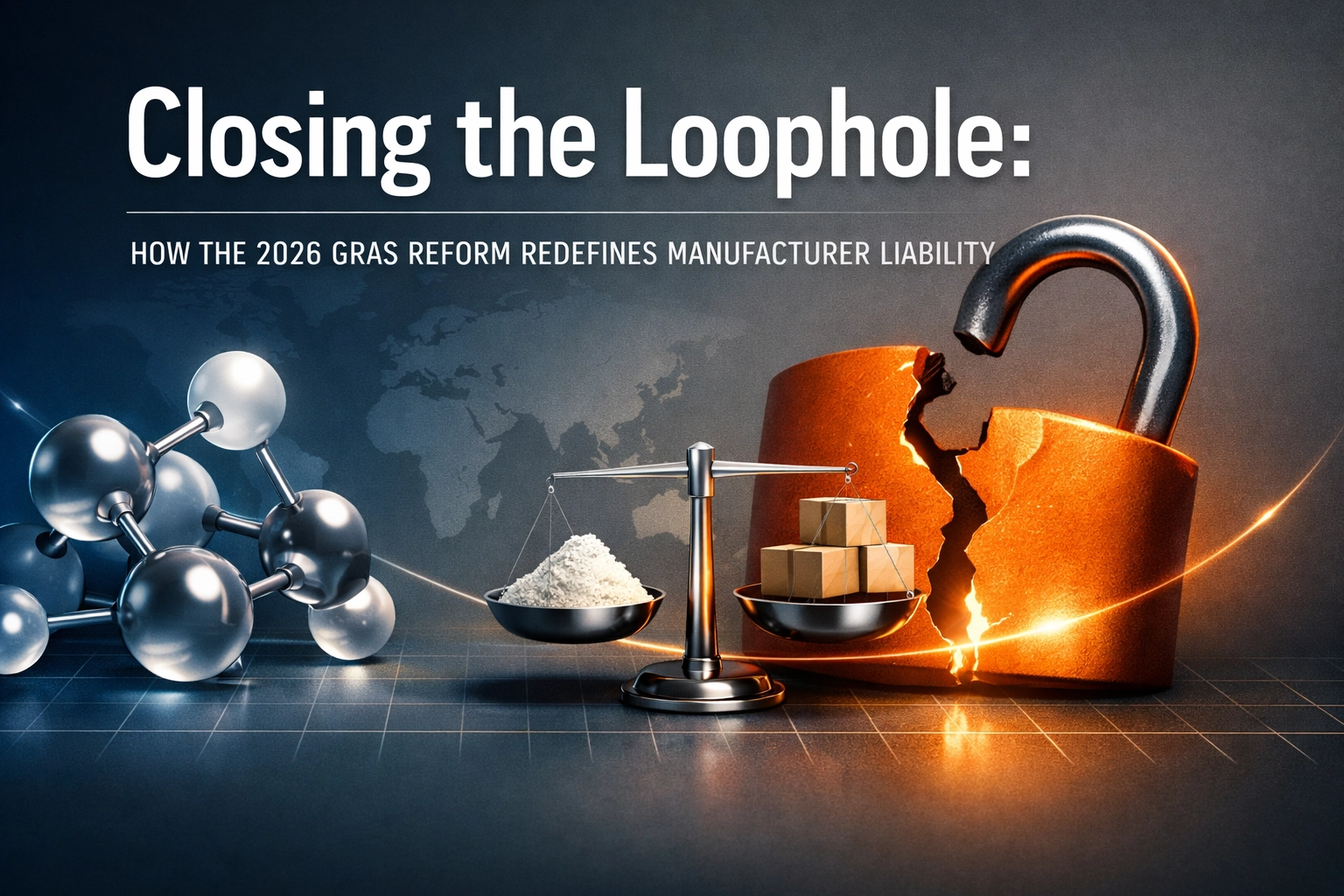
TL;DR: The 2026 GRAS Reform ends decades of self-certification for food ingredients. Manufacturers now face mandatory FDA notification (120 days pre-market for new ingredients, two-year window for legacy substances), while California AB 2034 adds independent state-level enforcement power. The burden of proof has shifted from “safe until challenged” to “prove it’s safe—continuously.” Organizations that treat this as a compliance cost will fall behind; those that treat it as brand equity will lead.
For decades, the food industry has operated on a “don’t ask, don’t tell” policy regarding ingredient safety. It’s the ultimate regulatory paradox: you could launch a new ingredient today, call it “safe” based on your own internal (and private) research, and wait for the FDA to tell you otherwise. But as of 2026, that handshake agreement is officially dead. The loophole is closing, and the liability is landing squarely on your desk. Is your supply chain ready for the light of day?
The End of the “Honor System”
Let’s be real: the “Generally Recognized as Safe” (GRAS) exemption was designed in 1958 for common-sense ingredients like vinegar and basil. It was never intended to be a backdoor for complex synthetic chemicals and novel bio-engineered compounds. Over time, however, it became exactly that: a pathway for manufacturers to self-certify ingredients without ever showing their homework to the FDA.
But the 2026 GRAS Reform has flipped the script. We are moving from a system of voluntary notification to mandatory transparency.
In the past, if a procurement lead found a cheaper stabilizer that was “self-affirmed GRAS,” the primary concern was cost and functionality. Today, that same decision carries a massive legal tail. If that ingredient hasn’t been vetted under the new 2026 standards, you aren’t just buying a chemical; you’re buying a lawsuit.

The Two-Front War: Federal Oversight and State Enforcement
The reform isn’t just one piece of paper; it’s a pincer movement between federal mandates and aggressive state-level legislation. To navigate this, you need to understand the two primary pillars of the new liability landscape.
1. The Federal Mandatory Notification Requirement
The FDA’s new rule, currently under final review, effectively ends the “self-affirmation” era. Manufacturers now face two critical deadlines:
- For New Ingredients: You must notify the FDA at least 120 days before hitting the market. No more launching first and asking for forgiveness later.
- For Legacy Ingredients: Any substance currently on the market through self-certification must be filed with the FDA within a two-year window.
This creates a massive operational bottleneck. If you have 50 SKUs relying on older, self-certified ingredients, you are now in a race against time to produce safety data that meets 2026 scientific standards—not the standards of 1995.
2. The California Effect (AB 2034)
While the FDA is tightening the leash, California is building a whole new fence. California AB 2034 is a game-changer. It requires manufacturers to prove to the California Department of Public Health (CDPH) that any additive introduced since 1958—that hasn’t had a formal FDA review—is actually safe.
California is also going after “incidental additives” that were previously exempt from federal labeling. If you want to sell in the fifth-largest economy in the world, your traceability documentation needs to be flawless. The state now has the power to prohibit “unsafe and poorly tested” chemicals independently of the federal government. For a national brand, this means you can no longer rely on a “one size fits all” compliance strategy.
The Retroactive Risk: Digging Up the Past
One of the most stressful aspects of the 2026 reform for C-suite executives is the retroactive safety assessment burden—and the regulatory trajectory suggests it won’t stop at a single filing.
Under the new framework, GRAS status is no longer a “one-and-done” achievement. The FDA’s expanded authority enables ongoing post-market reevaluations of chemicals and additives, which means the definition of “safe” can evolve as new data, methods, and exposure patterns emerge. Practically, that shifts the expectation from proving safety once to monitoring safety continuously.
Industry veterans are currently scrambling to find hard-copy files from thirty years ago to prove why a specific preservative was deemed safe. If that data is missing, incomplete, or based on outdated science, the ingredient is effectively “illegal” under the new reform.
This is where liability becomes personal. In a post-reform world, claiming “we didn’t know the supplier’s data was weak” is no longer a valid defense. The burden of proof has shifted. You are responsible for the integrity of every molecule in your product, all the way back to the source.
🧠 McBoeck Insight
At McBoeck, we don’t view the 2026 Reform as a regulatory hurdle; we view it as a market filter. The companies that will thrive are those that stop treating compliance as a “cost center” and start treating it as “brand equity.” Transparency is the new premium. When you can prove your ingredients are “beyond-compliance,” you aren’t just avoiding fines—you’re winning consumer trust that your competitors can’t buy.

Shifting the Strategy: From Procurement to Intelligence
If your procurement team is still buying ingredients based solely on Price, Quality, and Lead Time, you are exposed. In 2026, the fourth pillar must be Regulatory Intelligence.
Managing manufacturer liability requires a three-step strategic pivot:
- The Ingredient Audit: Every single SKU needs to be screened. Which ingredients are FDA-notified? Which are self-certified? Which rely on “legacy” data that won’t hold up under modern scrutiny?
- Supplier Accountability: It is time to stop taking your suppliers’ word for it. Demand the raw safety data. If they won’t share it, they are likely hiding a liability gap that will eventually become your problem.
- Adopting Higher Standards: The FDA’s floor is often too low for modern brand protection. This is why we developed the McBoeck Verified standard.
Why “McBoeck Verified” is the Safe Play
We recognized early on that the GRAS loophole was a ticking time bomb. That’s why our approach to ingredient sourcing has always been more “McKinsey” than “Middleman.”
The McBoeck Verified standard isn’t just about meeting the 2026 requirements—it’s about exceeding them so you never have to worry about the next reform. We look at the “Three Layers of Risk”:
- The Science: Is the toxicology data current?
- The Legality: Does it meet federal AND state-specific (CA, NY, WA) mandates?
- The Optics: How will this ingredient look on a label in 2028?
By sourcing through a vetted framework, you insulate your brand from the retroactive “shocks” that are about to hit the industry.
🧪 Real-World Application: The Emulsifier Pivot
A major snack food manufacturer recently realized their primary emulsifier was self-certified GRAS back in 2004. Under the 2026 reform, they faced a choice: spend $200k on new safety studies or reformulate. By pivoting to a McBoeck-sourced, FDA-notified alternative, they cleared their liability and actually improved their “clean label” score in the process. They didn’t just survive the reform; they used it to launch a “New & Improved” campaign.
Action Point: Don’t Wait for the Deadline
The 2026 deadline might feel like it’s a long way off, but the “120-day notification” rule means your R&D cycles are already being impacted. If you are developing products today for a 2027 launch, you are already operating under the new rules.
The “loophole” is gone. The era of mandatory transparency is here. The question is: will you be the one leading the charge, or the one caught in the audit?
Ready to bulletproof your portfolio? Download our 2026 Chemical Sourcing Playbook to see exactly how to navigate the new GRAS requirements and the California “111 Chemicals” list.
Or, if you’re ready to move from transactional sourcing to strategic intelligence, book a consult with our team and let’s get your ingredients “McBoeck Verified.”

This is Part 1 of our 5-week series on Strategic Ingredient Intelligence. Next week, we’re diving deep into the “California Effect” and how to navigate the dreaded 111 Chemicals list without losing your mind—or your market share.
This analysis is for informational purposes and does not constitute legal advice. Organizations should consult with regulatory counsel for specific compliance strategies.
Frequently Asked Questions
What is the 2026 GRAS Reform and why does it matter?
The 2026 GRAS Reform replaces the decades-old system of voluntary self-certification for “Generally Recognized as Safe” food ingredients with mandatory FDA notification. Manufacturers must now notify the FDA at least 120 days before marketing new ingredients, and legacy self-certified ingredients must be formally filed within a two-year window. This shifts the burden of proof from the FDA to manufacturers.
How does California AB 2034 affect food manufacturers nationally?
California AB 2034 gives the California Department of Public Health (CDPH) independent authority to require safety proof for any additive introduced since 1958 that hasn’t had a formal FDA review. Since California is the fifth-largest economy in the world, national brands must comply with these stricter state-level requirements in addition to federal rules, making a “one size fits all” compliance strategy obsolete.
What happens to ingredients that were self-certified GRAS before the reform?
Legacy ingredients that were self-certified under the old system must be formally filed with the FDA within a two-year compliance window. If the original safety data is missing, incomplete, or based on outdated science, manufacturers must either produce new safety studies meeting current standards or reformulate their products. GRAS status is also no longer permanent—the FDA can require ongoing post-market reevaluations.
What is the “McBoeck Verified” standard?
McBoeck Verified is a sourcing standard that evaluates ingredients across three layers of risk: scientific validity (current toxicology data), legal compliance (federal and state-specific mandates including CA, NY, and WA), and market optics (how the ingredient will be perceived on labels in 2028 and beyond). It is designed to exceed 2026 reform requirements so clients are insulated from future regulatory changes.
How should manufacturers prepare for the 2026 GRAS deadlines?
Manufacturers should take three immediate steps: (1) Conduct a full ingredient audit to identify which substances are FDA-notified versus self-certified, (2) Demand raw safety data from suppliers and evaluate whether legacy data meets current scientific standards, and (3) Adopt sourcing standards that exceed the FDA’s regulatory floor—such as the McBoeck Verified framework—to protect against retroactive liability and future reform cycles.